Sunday, October 18, 2015

TOW #6 – Article: “An Engineering Theory of the Volkswagen Scandal”

By Paul Kedrosky
October 16, 2015

In response to the September 2015 Volkswagen emissions scandal (aka Dieselgate), Paul Kedrosky, a venture investor and former equity analyst, analyzes how Volkswagen could have kept this a secret and who may have been behind this scandal.  He uses rhetorical questions and the strategies of comparison/contrast and cause/effect, in order to refute the widely held belief that Dieselgate is another corporate scandal driven by greed.

Kedrosky criticizes Michael Horn’s accusation that Volkswagen’s software engineers were to blame using rhetorical questions, thus causing his audience to ponder the accuracy of Horn’s accusation.  The author asks, “A couple of rogue engineers…? Sure, rogue financiers get caught up in scandals, but rogue engineers? And rogue German engineers…?” (para. 3).  His rhetorical questions effectively draw in readers with humor and sarcasm by stereotyping engineers and Germans, while also establishing the controversy about to be debated in his essay.  Although stereotypes are not objective evidence, these rhetorical questions create doubt in readers’ minds through the logical reasoning that engineers, especially punctilious German engineers, would not intentionally break the rules, especially in secret from their superiors.

Kedrosky builds onto his argument with more objective evidence when he reasons that since an automobile’s software consists of a hundred million lines of code, engineers would have trouble spotting the “defeat” device’s code.  To put such a statistic in a more understandable fashion for the general public, the author compares this to a form of travel that would seem even more technologically demanding: a space shuttle.  However, Kedrosky states the programming for a car requires “about two hundred and fifty hundred times the number of lines in the Space Shuttle” (para. 4).  With this comparison, the author helps readers understand the extent of how complex a car’s coding is to convince the general public that it is highly plausible that engineers missed new lines of code with each software update; as a result, over time, these mistakes may have evolved into the “defeat device” that subverted the rules.

The author also anticipates the counter-argument that some people would have noticed and should have spoken up, coming up with two causes explaining why Volkswagen employees would not.  Kedrosky states, “software changes the nature of our relationship to things, making rules feel malleable and more arbitrary” (para. 9), which is one reason why employees may not have felt they were committing illegal activities.  He gives an example that many people could relate to: stealing music.  Stealing CDs is obviously theft, but downloading MP3s does not (para. 9).  The second reason was a matter of Volkswagen pride, as the company had been failing to pass American emission tests, so writing such a code as the “defeat device” was justified in their minds. 

By drawing in readers and creating doubt in their minds using rhetorical questions, Kedrosky is then able to logically reason that software engineers could easily have missed the coding of the “defeat device,” as well as anticipate counter-arguments by analyzing the causes of why Volkswagen employees may not have spoken up if they did discover corrupt software, successfully making the argument that Dieselgate was most likely done with good intentions, but unfortunately resulted in catastrophic events that has ruined Volkswagen’s reputation.  

Saturday, October 10, 2015

TOW #5 – Article: "A Shifting Approach to Saving Endangered Species"

October 5, 2015
By Erica Goode

Erica Goode is the environmental editor for The New York Times, where she writes articles on national and international environmental issues.  She established the new environment department in 2009 at the Times.  In response to the Obama administration’s recent exclusion of the greater sage grouse from the endangered species list, Goode wrote this article explaining the scientific and ethical controversies surrounding America’s approach to saving endangered species.  She successfully defines the causes that have effected today’s controversy between groups of people in order to persuade conservationists that there is still hope for a solution, and that the first step towards compromise is to simply talk about the problem at hand and to combine contradicting ideas.  

The author structures her essay with headings, one being, “A Tradition of Distrust” (para. 20) of industry, which Goode argues is the ultimate source of the divisions between conservationists themselves and non-conservationists, who consist of private landowners and industries.  She then cites several supporting examples, including advocators for the spotted owl not trusting the timber industry to follow regulations (para. 30), as well as the inconsistent amounts of funding Congress allocates for each endangered species, since those that serve an industrial purpose receive more money (para. 25).  As a result, some conservationists believe more regulations and supervision should be instigated, while others take the side of having no human interference at all. 

Goode then explains the long-term effects of these divisions by quoting credible scientists and wildlife experts, including the director of the energy, environment, and land use program at Vanderbilt Law School, Professor Ruhl.  He states that “In the future… humans will take up more and more… leaving less for other species.  And society will ultimately have to set priorities and make difficult decisions” (para. 43).  By including his quote, Goode logically argues that making difficult decisions is inevitable.  Instead of tip-toeing around the issue, Goode then quotes the director of the Gund Institute for Ecological Economics at the University of Vermont, Taylor Ricketts, who says, “I don’t see why it’s a problem to talk… the big mistake has been to frame this as a choice” (para. 54), which is how the author calls on her audience, conservationists, non-conservationists, and government officials, to see the issue of endangered species as unavoidable and to welcome and debate controversial ideas in order to compromise on a plausible solution.

Sunday, October 4, 2015

TOW #4 – IRB: "On Beauty and Being Just" (Part 1)

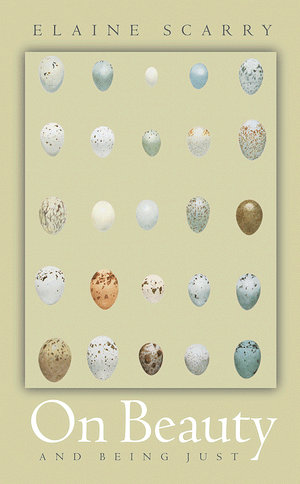
On Beauty and Being Just
By Elaine Scarry
Princeton University Press 1999

 As an essayist and English Professor at The University of Pennsylvania, Elaine Scarry has written several books.  Her most well-known books include Dreaming by the Book (1957), The Body in Pain (1985), and Rule of Law, Misrule of Men (2010).  Her essay, On Beauty and Being Just, was published in 1999 by the Princeton University Press in response to the political and scientific views that beauty was irrelevant or even harmful to academic discussion.  Scarry assesses the two main anti-beauty sentiments: (1) beauty distracts from the more important social issues (2) the beauty of an object makes people enjoy it in such a way that damages the beautiful object.  Through the rhetorical strategy of definition by allusions and imagery, Scarry writes to the general public to change its views on beauty and successfully redefines beauty; however, these rhetorical devices fail to support her argument that beauty makes people more concerned about justice.

The author redefines the perception of beauty by alluding to well-known works of art: “It may be startling to speak of the Divine Comedy or the Mona Lisa as ‘a replication’” (Scarry 10).  She then goes on to explain that beauty prompts onlookers into action: to copy such beauty and translate it into other forms.  In doing so, onlookers will search for the originating source of the beauty they see and eventually reach “something that has no precedent… the immortal,” which is the realm where “truth abides,” and how beauty will ultimately lead people to strive for justice.  Scarry’s train of thought jumps from topic to topic, only slightly relating each idea, which does not make for strong supporting evidence for her argument. 

Scarry also conveys the magnitude of beauty’s effects on humans using imagery and personification.  She uses several examples of Henri Matisse’s works to emphasize the increasing prevalence of the beautiful palm trees in Matisse’s paintings, to the point that a palm tree eventually takes up over half of the surface of his 1948 painting.  Scarry writes, “It feathers across the eye, excites it, incites in it saccadic leaps and midair twirls” (Scarry 35).  This imagery displays the idea that beauty will inspire onlookers into action: to look for truth and justice.  Later on, Scarry also ties in the aspects of beautiful symmetry and fairness, the “perfect cube” and justice (Scarry 95) in order to relate beauty and being just.  Once again, the author takes ideas and fails to successfully connect her disjointed ideas into a firm conclusion.  

So far, I find it disappointing that Scarry has been unable to convince me of a relationship between beauty and justice, which interested me because they seem like entirely unrelated ideas.  However, I am enjoying her novel ideas about the concept of beauty that is different from how I have ever seen beauty before.

Sunday, September 27, 2015

TOW #3 – Visual: “Immigrants are Ruining the Economy”

Amptoons Comics
January 28, 2008
By Barry Deutsch

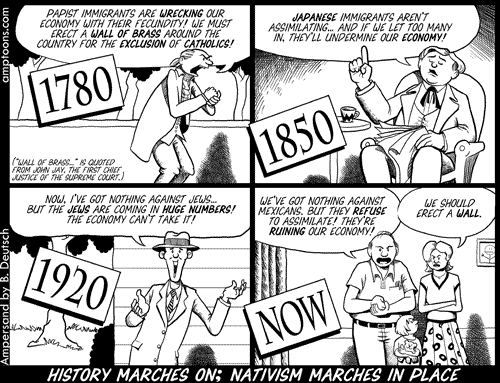
Barry Deutsch is the political cartoonist behind the comic, Ampersand, published in the Dollars and Sense Magazine.  This magazine provides news, analyses, and reports specifically about the economy for its readership, which consists of mostly students and professors.  In Ampersand’s January 2008 issue, Deutsch makes fun of how American nativism has always driven people to scapegoat immigrants for economic problems.  He specifically references the economic crisis of the 1780s, the Panic of 1857, the Depression of 1920, and the Financial Crisis of 2008.  Utilizing juxtaposition and the exaggeration of his character’s facial expressions, Deutsch appeals to the humor of younger generations in order to successfully emphasize how immigrants have always taken the blame for every economic recession in America. 

The author divides the cartoon into four equal squares with one example of scapegoating immigrants in each square.  There is a uniform structure for each example: some character criticizing the immigrants in front of some corresponding background from that year, and a smaller box with date in big bold letters.  This uniformity helps show students that although decades separate each example with every square depicting a different group of people, every instance is essentially the same American citizen asserting unfounded accusations, born from nativism. 

Deutsch also depicts his characters in a humorous way to generate interest from younger generations.  His exaggeration of their expressions, especially with their extreme eyebrows, oddly-shaped gaping mouths, and firm positions of their hands, is how Deutsch ridicules each character, conveying the message that these people and their accusations are ridiculous. 

However, there are exceptions to the above two “visual” devices Deutsch uses.  Deutsch slightly breaks uniformity in the last square when instead of putting “2008”, he writes “NOW.” There is also one character who is devoid of any of the “ridiculous” aspects, and actually only appeals to the audience’s “aww” emotions; this character being the child in the last square.  In doing so, the author points out that although nativism has dominated American history, there is hope in breaking this cycle because now, it is up to the younger generations, who have the choice to follow their predecessors or to make their own future and treat immigrants differently.  

Sunday, September 20, 2015

TOW #2 – Article: “In Migrant Crisis: German Generosity Comes Under Fire”

The Washington Post
"In Migrant Crisis, German Generosity Comes Under Fire"
September 7, 2015
By Anthony Faiola and Michael Birnbaum 

Anthony Faiola is currently the Post’s Berlin bureau chief and has written many reports for the paper since 1994.  In this article, he collaborates with Michael Birnbaum, who is the Post’s Moscow bureau chief and previously served as a Berlin correspondent.  Together, they published this article on September 7, reporting on Germany taking fire after pledging to take in 500,000 migrants annually.  Faiola and Birnbaum stated that European leaders blamed Germany for essentially motivating migrants to their deaths with “benefits so lucrative” (para. 3).  In response, Germany lowered the amount of cash handouts to asylum seekers and promised other forms of aid that would be beneficial to migrants in the long run. 

Although the article seems largely factual-based because of its short and simple syntax with the majority of the article consisting of quotations from politicians, Faiola and Birnbaum subtly make an argument about how in some cases, generosity can be harmful.  The authors are most likely writing to warn other European nations about the complexity of this migrant crisis and that in order to help keep asylum seekers safe, less should be offered to prevent them from making dangerous journeys across land and sea. 

Most European nations are being criticized for not doing more to help these migrants; however, Hungary’s leader, Viktor Orban is quoted saying, “Just between us, you know, the problem is not a European problem. The problem is a German problem” (para. 22).  By quoting credible speakers involved in this conflict, Faiola and Birnbaum establish their ethos and also argue that Germany’s monetary promises will lead to a lot more deaths from attempts to take dangerous travel routes.  Orban’s quote also carries an incriminating tone, showing conflict between nations, which is also unfavorable in a conflict that requires the help of all European nations together.  Faiola and Birnbaum quoted leaders whose words would support their argument, allowing them to successfully persuade other nations that promising financial aid is not the solution to the migrant crisis, and neither is putting the blame on others who should be commended for their efforts.

Sunday, September 13, 2015

TOW #1 – Article: "Trump and Obama: A Night to Remember"

The New Yorker
September 12, 2015
By Adam Gopnik

As a staff writer of the New Yorker since 1986, Adam Gopnik has contributed fiction, non-fiction, book reviews, humor, criticism, and internationally reported pieces.  On September 12, 2015, reporting on the fiery occurrences at the White House Correspondents’ Association dinner in 2011, Gopnik enlightens the New Yorker newspaper’s readership with his thought-provoking commentary.  Gopnik’s apparent purpose is to share such humorous news, describing the event as “the usual American ritual of the ‘roast’” (Gopnik para. 7), but how can this article be considered “news” if people had already known about President Obama’s outrageously witty gibes at Donald Trump?  The author goes beyond reporting old news; he writes a cause and effect essay for the purpose of identifying a possible cause for the strange phenomenon of Trump’s stunning lead in the polls.

Gopnik begins by summarizing the highlights of the dinner and quoting only a few of Obama’s most provocative gibes, which serve to quickly refresh his audience’s memory of what occurred four years ago, as well as form the context of his analysis.  Using figurative language, such as simile and personification, he writes, “his head set in place, like a man in a pillory, he barely moved or altered his expression as wave after wave of laughter struck him” (Gopnik para. 3).  Gopnik emphasizes the “parts” of the dinner to introduce the cause he identifies: Trump’s humiliation and anxiety. 

The author then relates such “parts” to the “whole,” his overall argument.  To help his audience’s understanding, he defines the difference between the ideologies of a patriot and a populist nationalist, explaining that “it rests not on a sense of pride in place or background but in an intense sense of victimization (Gopnik para. 7). Gopnik argues that America feels victimized from a “double conspiracy of outsiders and elitists” (Gopnik para. 4), which is what both Trump and the American people have in common, and how Trump has been able to gain the incredible amount of support he has in the polls.

Gopnik bridges his evidence of Trump’s shame, America’s anxiety, and the basis of populist nationalism, ultimately synthesizing his argument about how Trump achieved his current success in the polls.  In doing so, Gopnik appeals to the audience’s sense of logic and reason, successfully convincing readers of one possible reason for Trump’s peculiar political success.

Tuesday, September 8, 2015

IRB Intro Post #1

            For the first marking period, I have decided to read On Beauty And Being Just by Elaine Scarry.  Since I have always been interested in science related non-fiction, I would like to start reading more expansively, beginning with Elaine Scarry’s philosophical book about beauty.  As an avid fan of art, I thought Scarry’s arguments about beauty would somewhat interest me and serve as a bridge towards more foreign non-fiction subjects.  I do believe some parts may put me to sleep, but I hope I will develop an endurance for boring texts, as well as pick up new vocabulary and learn about Scarry's point of view on beauty's purpose in society.